Sunday, March 22, 2009

Battery Tester Project Using LM3914 IC

This objective of this project is to design and build a battery tester that is able to test various types of dry cell and rechargable battery with a voltage of less than 2V. Configured as a bar graph battery level indicator, the LM3914 IC from National Semiconductor senses the voltage levels of the battery under test and drives the 10 LEDs to ON or OFF based on the voltage that is detected. The current driving the LEDs is regulated by using the external resistor R1 and hence limiting resistors are not required.

The schematic shows the simple connections where the reference voltage at pin 8 of U1 can be adjusted by adjusting the variable resistor VR1. The voltage at pin 8 will set the maximum scale of the LED. In testing dry cell battery of 1.5V, set the voltage at pin 8 to 2.0V. Each of the LED will thus represent 200mV when lighted up.

If testing of rechargable battery such as NiCd or NiMH is required, set the reference voltage to a lower value such as 1.5V as the typical voltage of a rechargable battery is approximately 1.2V.
When testing the battery, take note of the polarity of the probe to the terminals of the battery. T1 is to be placed on the positive terminal and T2 the negative terminal of the battery.

Parts List
The parts list of the project is as shown below.

Digital Dice Project

Digital Dice
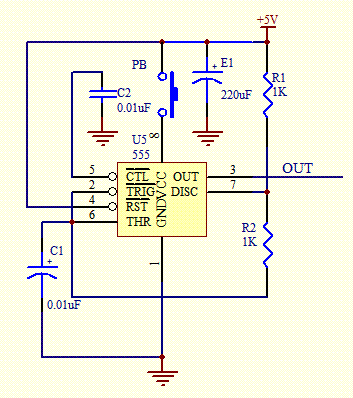
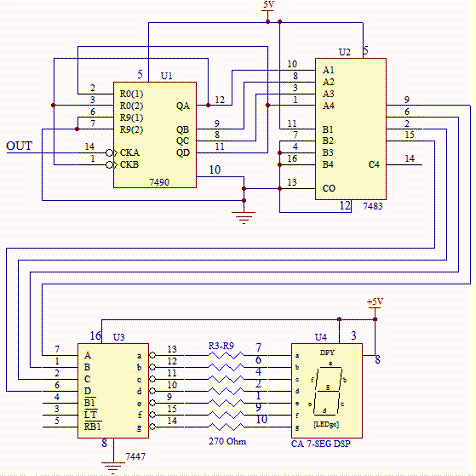
This digital dice project is an interesting project that will display in random the number from 1 to 9 on the 7 segment display. This is an alternative device that can be used to replace the traditional dice when you are playing games such as snake ladder, monopoly etc. The generation of clock is done by using a 555 timer which is connected in the astable mode at a frequency of approximately 50 Hz. This clock signal is fed into the decade counter which outputs are connected to 4 bit binary adder which provides a binary output equavalent to binary input + 1. The outputs are then connected to a BCD to 7 Segment Decoder which is used to drive a common anode 7 segment display.


As shown in the schematic above, when push button PB is pressed, a square output will be generated from the 555 timer which gives a frequency of approximately 50 Hz to the 7490 decade counter IC. The frequency of the astable 555 timer is calculated by using the standard formula of the timer.
f = 1.44/(1K + 2*1K)(0.01uF) = 48 Hz.


The output from the 555 timer is then connected to the input of U1 7490 decade counter. When the decade counter reach the count of 9, the outputs of QA and QD will go to logic "1" and the counter is reset. The 7447 BCD to 7 segment decoder is used to drive the 7 segment common anode display.
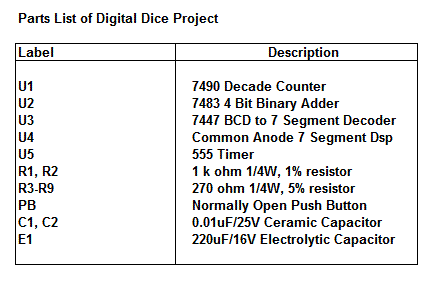
Parts List

Thursday, March 19, 2009

Students Projects Exchange


Dear friends this blog started for the students 

who need help to create their final collage projects.

Here we share the project ideas, schematics, PCB Designs and Interfacing codes